

















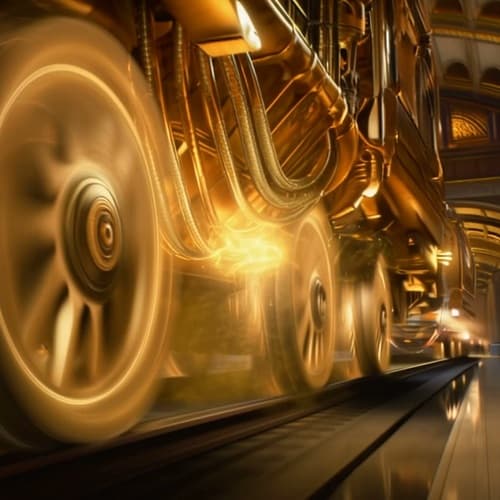









Trains are inventions that have completely transformed the world. When George Stephenson built the first steam locomotive in 1814, he could not have imagined that his creation would become a symbol of progress, adventure, and the dreams of humanity. Trains are not just vehicles—they connect people, cultures, and continents.
The Golden Train, or the world's most famous railways, come in many forms. Some take you through the Himalayas, some cross vast deserts, some curve along the sea, and others cut through tropical rainforests. Each line has its own story, history, and charm that attracts travelers from around the globe to experience something truly unforgettable.
The History of Trains and the Industrial Revolution
Trains emerged during the Industrial Revolution, when humans discovered how to harness steam power to drive machines. Before this, land transport relied mainly on animal power—horses, mules, or oxen pulling carts were the fastest means. Traveling between cities took days or weeks, and trade was limited by the inability to move large quantities of goods.
George Stephenson's first steam locomotive, "Locomotion No. 1," could travel about 24 km/h, which was very fast at the time. In 1825, the first commercial steam railway opened between Stockton and Darlington in England. This marked the beginning of the railway era that would change the world forever.
The importance of trains to the world:
- Transport revolution: Reduced travel time from days to just hours
- Economic boost: Opened new markets and made intercity trade easier
- Urban expansion: Cities with train stations grew faster than others
- Connecting people: Made it easier for people to visit relatives
- Technological development: Spurred advances in metallurgy, engineering, and industry
- Changed the concept of time: Standard time was needed to schedule trains
The development of trains in the 19th century was rapid. Countries competed to build railways. The US built the transcontinental railroad connecting the east and west coasts. Russia built the Trans-Siberian Railway linking Moscow to Vladivostok. British-ruled India built the largest railway system in Asia. Every route was an engineering marvel.
In Thailand, trains began during King Rama V's reign in 1897 with the construction of the Bangkok-Nakhon Ratchasima line, the start of the State Railway of Thailand. King Chulalongkorn saw the importance of trains for national development and maintaining independence.
🚂 Try the Golden Train Randomizer →
The Trans-Siberian Railway - The Longest Route in the World
The Trans-Siberian Railway is the world's longest railway, stretching over 9,289 km from Moscow to Vladivostok on the Pacific coast. The full journey takes about 7 days, crossing 8 time zones and 16 major rivers, including the Volga and Ob.
Construction began in 1891 under Tsar Alexander III of Russia and took 25 years to complete, facing many hardships—temperatures as low as -40°C, difficult terrain, and labor shortages.
Interesting facts about the Trans-Siberian:
- Distance: 9,289 km, the longest in the world
- Travel time: 6-7 days for a direct route
- Stations: Over 990 along the route
- Major bridge: Amur River Bridge, 2.6 km long
- Construction cost: About 1.5 billion gold rubles at the time
- Labor: Over 90,000 workers, mostly prisoners and soldiers
The scenery changes dramatically along the way, from big cities like Moscow, through the vast taiga forests, across the Ural Mountains (the boundary between Europe and Asia), past Lake Baikal—the world's deepest and largest freshwater lake—and finally to the Pacific coast.
Lake Baikal is a highlight, over 25 million years old, 1,642 meters deep, and holding about 20% of the world's surface fresh water. Its water is so clear you can see 40 meters down. In winter, the ice is up to 1 meter thick—cars can drive on it.
The Trans-Siberian was strategically important in both World Wars for transporting troops, weapons, and supplies. Today, it remains a vital trade route and a dream journey for travelers worldwide.
The Orient Express - Luxury on Rails
The Orient Express is a symbol of luxury and mystery. Since its launch in 1883, it connected Paris to Istanbul, passing through major European cities. The full journey took about 3 days and became the most luxurious and romantic travel experience in the world.
The Orient Express was more than a train—it was a five-star hotel on wheels. Carriages were decorated with high-quality teak, velvet, and silk, with crystal lamps, large mirrors, and custom furniture. Bedrooms had soft beds, fine linens, and personal service.
Highlights of the Orient Express:
- Dining car: Served fine French cuisine on white linen
- Cocktail bar: Offered drinks and live music
- Dress code: Passengers dressed formally for dinner
- Service: Personal attendants for every need
- Route: Passed through the Alps with stunning views
- Mystery: Setting for Agatha Christie's detective novel
Agatha Christie wrote "Murder on the Orient Express" in 1934, one of her most famous works, about a mysterious murder on the train solved by detective Hercule Poirot. The book's success made the Orient Express a cultural icon.
At its peak, the Orient Express was the train of royalty, actors, politicians, and the global elite. Kings and queens traveled on it, and it was the site of diplomatic negotiations, business deals, and romantic stories.
The original service ended in 1977 due to competition from faster, cheaper airplanes. But in 1982, the Venice Simplon-Orient-Express was revived using meticulously restored original carriages. It still operates today, offering a luxury experience for travelers willing to pay tens of thousands of dollars.
The Death Railway in Thailand
The Death Railway is a railway with a tragic history in Thailand. Built by the Japanese during World War II to connect Thailand and Burma, it was used to transport troops and supplies for the war in Burma and India. Construction began in 1942.
It is called the "Death Railway" because so many died during its construction—about 12,000-16,000 Allied POWs and 80,000-100,000 Asian laborers died from disease, starvation, overwork, and brutal treatment. The grim statistic: one death for every railway sleeper laid.
Facts about the Death Railway:
- Distance: About 415 km from Nonthaburi to Thanbyuzayat, Burma
- Construction time: 16 months instead of the planned 5 years
- Deaths: Over 100,000 POWs and civilians
- Working conditions: 18-hour days in heat and rain
- Diseases: Malaria, cholera, and infections killed many
- Key site: Bridge over the River Kwai, the most famous spot
The Bridge over the River Kwai is the symbol of the Death Railway. The original wooden bridge was bombed by the Allies in 1945; after the war, a steel bridge was built. Today, the bridge is still in use, with trains passing daily, and is a major tourist attraction in Kanchanaburi.
The film "The Bridge on the River Kwai" (1957), directed by David Lean, won 7 Oscars. Though the film altered some historical facts, it brought global attention to the Death Railway and the suffering of POWs.
Today, the line runs from Bangkok to Nam Tok (Sai Yok District, Kanchanaburi), a popular tourist route for Thais and foreigners. The journey across wooden bridges, along cliffs, and through mountain tunnels is thrilling and a reminder of painful history.
Swiss Trains and Mountain Routes
Switzerland has one of the best railway systems in the world—not only punctual and clean, but with routes passing through the stunning scenery of the Alps. Many Swiss trains are designed for tourism, with large panoramic windows for viewing.
The Glacier Express is the slowest express train in the world, running from Zermatt to St. Moritz in 8 hours over 291 km, averaging just 36 km/h. The slow pace is intentional, as the route crosses 291 bridges, 91 tunnels, and reaches 2,033 meters above sea level.
Famous Swiss trains:
- Glacier Express: Through the Alps from Zermatt to St. Moritz
- Bernina Express: Over the Alps to Italy, a UNESCO World Heritage route
- Golden Pass Line: Connects Montreux and Lucerne through lakes and mountains
- Jungfrau Railway: To the highest station in Europe at 3,454 meters
- Gornergrat Railway: For views of the Matterhorn, the world's most beautiful peak
- Pilatus Railway: The steepest railway in the world, with a 48-degree incline
The Bernina Express was listed as a UNESCO World Heritage site in 2008. The 122 km route runs from Chur, Switzerland, to Tirano, Italy, passing snowy mountains, glaciers, valleys, and fairy-tale villages.
A highlight is crossing the Landwasser Viaduct, a 65-meter-high stone bridge with 6 arches, leading straight into a cliff tunnel. The scenery is so beautiful it has inspired countless postcards. Built from 1901-1903, the bridge is an engineering marvel.
Swiss trains offer the Swiss Travel Pass, allowing tourists unlimited travel on all trains, buses, and lake boats. About 70% of Swiss people use public transport regularly.
Japanese Trains and the Shinkansen
Japan has the world's most advanced and punctual railway system. The Shinkansen, or Japanese bullet train, began service in 1964 before the Tokyo Olympics—the world's first high-speed rail, reaching 210 km/h at the time.
Today, new Shinkansen models reach 320 km/h, with many lines connecting major cities. The Tokaido Shinkansen (Tokyo-Osaka) is the world's busiest, with trains every 3-10 minutes during rush hour.
Shinkansen highlights:
- Punctuality: Average delay just 0.9 minutes per year
- Safety: No passenger fatalities ever
- Cleanliness: Entire train cleaned in 7 minutes between runs
- Technology: Automatic control and earthquake protection
- Nose design: Modeled after the kingfisher to reduce tunnel boom
- Service: High-quality bento meals and trolley service
The long nose of new Shinkansen models was inspired by the kingfisher bird. Engineer Eiji Nakatsu, a birdwatcher, noticed kingfishers dive from air to water with barely a splash. He applied this to the train's nose, reducing tunnel boom by 30% and saving 15% energy.
Japan is developing Maglev trains that will reach 500 km/h, using magnets to levitate the train above the track, nearly eliminating friction. Tests have reached 603 km/h. The Tokyo-Nagoya line is expected to open in 2027, cutting travel to just 40 minutes.
Besides speed and punctuality, Japan has many special tourist trains, like the Seven Stars in Kyushu—luxurious with teak and gold, starting at $10,000 for a 4-day, 3-night trip—or the Twilight Express Mizukaze, which runs along the Sea of Japan with luxury suites.
Desert Trains - The Ghan of Australia
The Ghan is a train that crosses the heart of Australia, from Adelaide in the south to Darwin in the north, 2,979 km in 54 hours. It passes red deserts, purple mountains, and vast savannahs. The name "Ghan" comes from Afghan camel drivers who transported goods before trains.
Traveling on The Ghan is an adventure through wild, beautiful lands. The first stretch passes the Flinders Ranges, with 800-million-year-old rocks, then into endless desert—just red earth, blue sky, and sparse trees.
The Ghan experience:
- Luxury carriages: Private bedrooms, en-suite bathrooms, wide windows
- Fine dining: Chefs prepare fresh meals with local ingredients
- Sightseeing stops: Passengers can disembark at key sites
- Alice Springs: A desert town stop for nature tours
- Katherine Gorge: Deep, beautiful canyon with boat tours
- Best season: Dry season, April-October
Building the railway through the Australian desert was a huge challenge—daytime temperatures up to 50°C, nights below zero, tracks expanding and contracting, sand covering rails, and flash floods in the wet season.
The original route from Adelaide to Alice Springs opened in 1929, taking 2 days but often disrupted by floods. In 2004, the line was extended to Darwin, making it possible to cross Australia from south to north by train for the first time.
At night on The Ghan, passengers see a sky full of stars, with the Milky Way bright and clear—a rare experience in the modern world.
The First Transcontinental Railroad in America
America's first transcontinental railroad connected the east and west coasts, completed in 1869—a milestone that truly united the country. Before, travel from New York to San Francisco took 6 months by wagon or ship; with the railroad, just 7 days.
Construction began from both ends: Central Pacific from California eastward, Union Pacific from Omaha westward. Both companies raced to lay more track, as government subsidies were paid per mile.
Transcontinental Railroad facts:
- Construction time: 6 years (1863-1869)
- Labor: Tens of thousands of Chinese workers in the west
- Difficulties: Laying track through the Sierra Nevada and Rocky Mountains
- Meeting point: Promontory Summit, Utah
- Golden Spike: Symbolic final spike joining the rails
- Impact: Changed America's economy and society forever
Chinese laborers faced immense hardship—lower pay than whites, the hardest and most dangerous jobs, blasting through mountains, laying track on cliffs. Thousands died from accidents, disease, and harsh weather.
In the winter of 1866-67, Chinese workers tunneled through mountains in deep snow, with avalanches burying camps. Some bodies were only found in spring. Still, they worked on to send money home to China.
The railroad's completion spurred rapid development of the American West, new towns sprang up, trade flourished, and people migrated west. But it also devastated Native American ways of life.
The Blue Train of South Africa
South Africa's Blue Train is one of the world's most luxurious trains, running from Cape Town to Pretoria, 1,600 km in 27 hours. In service since 1923 (originally as the Union Limited, renamed Blue Train in 1946), the blue train is a symbol of African luxury.
Blue Train suites are like five-star hotel rooms—private bathrooms, large beds, wardrobes, air conditioning, hardwood furniture, marble, and fine fabrics. Each suite has a personal butler.
Blue Train luxury:
- Suites: 11 sq m with bathtubs
- Fine dining: Private table service in your suite
- South African wine: Selection of the best
- Silk pajamas: Provided for guests
- Laundry service: Free laundry
- Lounge car: Piano, bar, panoramic views
The journey passes diverse scenery—Cape Town's beautiful harbor, Western Cape vineyards, the vast Karoo semi-desert, ending in Pretoria. Passengers see African wildlife, mountains, and small villages.
Tickets start at about 20,000 rand (about $1,000) for a Deluxe Suite, up to 40,000 rand ($2,000) for a Luxury Suite—all-inclusive: food, drinks, personal service, and a rare experience.
The Blue Train has carried many famous passengers—British royalty, presidents, actors, and billionaires. Its reputation makes it a symbol of South Africa and African luxury.
Trains of the Future - Hyperloop and New Technologies
Elon Musk, founder of Tesla and SpaceX, proposed the Hyperloop in 2013—a transport system using capsules in vacuum tubes at speeds up to 1,200 km/h, faster than commercial jets. This idea could revolutionize travel.
The Hyperloop works by reducing air resistance to near zero in a vacuum tube. Capsules float on magnetic or air cushions, propelled by linear electric motors. With almost no drag, they can reach very high speeds.
Future train technologies:
- Hyperloop: 1,200 km/h in vacuum tubes
- Maglev: Magnetic levitation trains at 500+ km/h
- Hydrogen trains: Clean energy, zero emissions
- Driverless trains: Controlled by AI and sensors
- Solar railways: Solar panels on roofs
- Tube trains: High-speed underground trains
Many companies are testing Hyperloop. Virgin Hyperloop carried its first passengers in 2020 in Las Vegas. Countries like the UAE, India, and Europe have Hyperloop projects.
But there are challenges—huge construction costs, maintaining a vacuum over hundreds of kilometers, long-term safety, and legal/land issues. Some critics say Hyperloop is just a dream, while supporters believe it's the future of transport.
Japan is also developing Maglev seriously—the Tokyo-Nagoya line opens in 2027, Osaka in 2045, with speeds up to 500 km/h (Tokyo-Nagoya in 40 minutes vs. 90 by Shinkansen).
China is developing Maglev too, with a 430 km/h line in Shanghai and new lines planned, including a 600 km/h project.
Conclusion
Trains have changed the world forever since their invention over 200 years ago. From the first steam locomotive at 24 km/h to high-speed trains at nearly 400 km/h, and in the future, maybe 1,200 km/h with Hyperloop, trains are symbols of technological progress and human ambition.
Key discoveries:
- World revolution: Trains changed how we travel, trade, and connect
- Engineering marvels: Railways through mountains, deserts, and oceans show human capability
- History: Every route has stories of triumph and tragedy
- Diversity: From luxury trains to everyday lines, every country is unique
- Future: New tech will make travel faster and greener
- Human heritage: Railways are a cultural legacy to preserve
- Experience: Train journeys offer what planes and cars cannot
From the Trans-Siberian crossing the world's largest landmass, to the Death Railway reminding us of war's cost, from the elegant Orient Express to the precise Shinkansen, every route has lessons and beauty to offer.
Trains are not just vehicles—they are experiences, adventures, chances to see the world through a window, meet people from different cultures, slow down from daily chaos, and reflect as the scenery changes. Train travel teaches patience, valuing the journey over the destination, and openness to new experiences.
Ready to randomly select a Golden Train? Try our Golden Train Randomizer to add fun and surprise to your activities. Let the excitement of train journeys be part of your memorable experience.
Interested in other topics? See Chinese Trains Travel or Other Randomization Methods